National Company Law Appellate Tribunal (NCLAT): Detailed Jurisdiction Overview
Dated
0
टिप्पण्या
National Company Law Appellate Tribunal (NCLAT): Detailed Jurisdiction Overview
The National Company Law Appellate Tribunal (NCLAT) is a specialized appellate body established under Section 410 of the Companies Act, 2013, constituted by the Central Government with effect from 1st June, 2016. It serves as the primary appellate forum for reviewing decisions of the National Company Law Tribunal (NCLT) and certain other quasi-judicial authorities in India's corporate dispute resolution system.
The NCLAT consists of a Chairperson (typically a senior retired judge) along with Judicial and Technical Members appointed by the Central Government. Unlike the NCLT which operates through 15 benches across India, the NCLAT is centralized at New Delhi, functioning as a single appellate tribunal where all appeals are filed and heard.
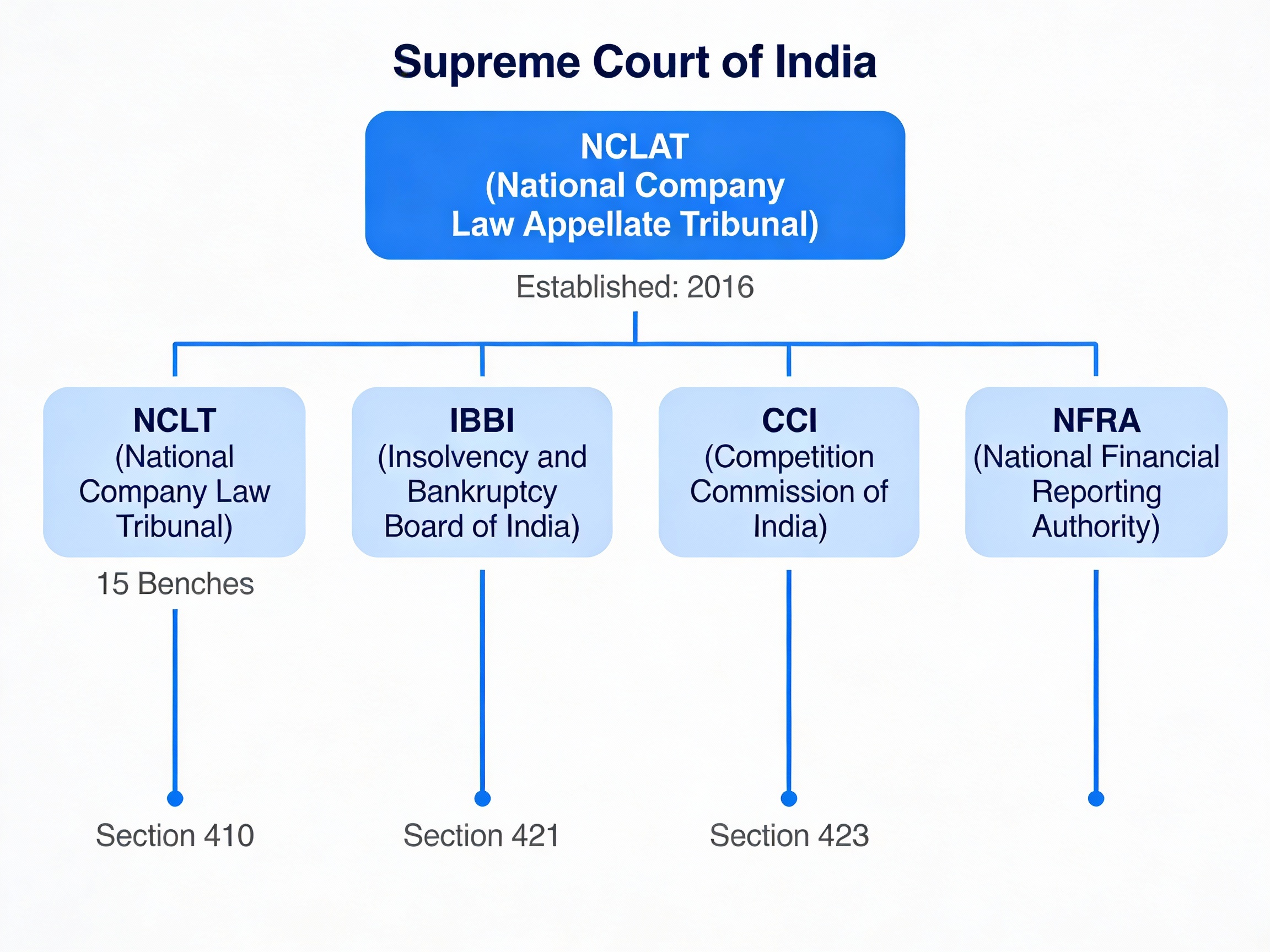
Four Primary Appellate Jurisdictions
NCLAT exercises appellate jurisdiction over four distinct domains:s3.amazonaws
.png)
1. Appellate Jurisdiction Over NCLT Orders (Section 421, Section 61 IBC)
The NCLAT hears appeals against NCLT orders relating to company law matters under the Companies Act, 2013 and insolvency matters under the Insolvency and Bankruptcy Code, 2016.
Company Law Matters include oppression and mismanagement claims (Sections 241-242), winding up orders (Sections 271-307), mergers and demergers (Sections 230-234), share transfers and transmission (Sections 58-59), deposits and class actions, and rectification of company registers.
Insolvency Matters include corporate insolvency resolution process decisions, liquidation proceedings, fraudulent trading orders (Section 66 IBC), undervalued and extortionate transaction avoidance (Sections 50-51 IBC), and Insolvency Professional decisions.
Organizational Structure
The NCLAT consists of a Chairperson (typically a senior retired judge) along with Judicial and Technical Members appointed by the Central Government. Unlike the NCLT which operates through 15 benches across India, the NCLAT is centralized at New Delhi, functioning as a single appellate tribunal where all appeals are filed and heard.
NCLAT's Position in India's Appellate Judicial System
Four Primary Appellate Jurisdictions
NCLAT exercises appellate jurisdiction over four distinct domains:s3.amazonaws
.png)
NCLAT Appellate Jurisdiction: Bodies and Appellate Hierarchy
1. Appellate Jurisdiction Over NCLT Orders (Section 421, Section 61 IBC)
The NCLAT hears appeals against NCLT orders relating to company law matters under the Companies Act, 2013 and insolvency matters under the Insolvency and Bankruptcy Code, 2016.
Company Law Matters include oppression and mismanagement claims (Sections 241-242), winding up orders (Sections 271-307), mergers and demergers (Sections 230-234), share transfers and transmission (Sections 58-59), deposits and class actions, and rectification of company registers.
Insolvency Matters include corporate insolvency resolution process decisions, liquidation proceedings, fraudulent trading orders (Section 66 IBC), undervalued and extortionate transaction avoidance (Sections 50-51 IBC), and Insolvency Professional decisions.
2. Appellate Jurisdiction Over IBBI (Section 202, 211 IBC)
NCLAT hears appeals against orders and decisions of the Insolvency and Bankruptcy Board of India (IBBI) issued after December 1, 2016. This includes appeals concerning Insolvency Professional regulation, suspension or cancellation of IP registration, and IBBI's administrative and regulatory decisions.
2. Appellate Jurisdiction Over IBBI (Section 202, 211 IBC)
NCLAT hears appeals against orders and decisions of the Insolvency and Bankruptcy Board of India (IBBI) issued after December 1, 2016. This includes appeals concerning Insolvency Professional regulation, suspension or cancellation of IP registration, and IBBI's administrative and regulatory decisions.
3. Appellate Jurisdiction Over CCI (Section 53N Competition Act, 2002)
Through amendments effective from May 26, 2017, the NCLAT acquired appellate jurisdiction over Competition Commission of India (CCI) decisions. This includes appeals against orders on abuse of dominance, cartel violations, merger approvals or rejections, penalty orders, and compliance directions.
3. Appellate Jurisdiction Over CCI (Section 53N Competition Act, 2002)
Through amendments effective from May 26, 2017, the NCLAT acquired appellate jurisdiction over Competition Commission of India (CCI) decisions. This includes appeals against orders on abuse of dominance, cartel violations, merger approvals or rejections, penalty orders, and compliance directions.
4. Appellate Jurisdiction Over NFRA (Section 83, Companies Amendment Act 2017)
With effect from May 7, 2018, NCLAT hears appeals against National Financial Reporting Authority (NFRA) orders concerning auditor professional misconduct, audit quality standards, disciplinary action against practitioners, and registration matters.
4. Appellate Jurisdiction Over NFRA (Section 83, Companies Amendment Act 2017)
With effect from May 7, 2018, NCLAT hears appeals against National Financial Reporting Authority (NFRA) orders concerning auditor professional misconduct, audit quality standards, disciplinary action against practitioners, and registration matters.

NCLAT's appellate powers include the ability to reappraise evidence, examine legal issues, and determine whether the NCLT acted within jurisdiction. The tribunal can confirm, modify, or set aside NCLT orders, or remand matters to NCLT with directions for reconsideration.
Critical Limitations
No Review Power: Though NCLAT possesses inherent powers under Rule 11 of the NCLAT Rules, 2016, it cannot review its own orders in the traditional sense. The distinction between "review" and "recall" is well-established—while NCLAT can recall its own orders to rectify procedural errors (such as when a necessary party was not served), it cannot reopen matters to correct substantive legal reasoning.
No De Novo Examination: NCLAT cannot conduct fresh hearings as if it were the first tribunal, receive new evidence not presented before NCLT, or make independent factual findings.
Restricted Standard of Review: NCLAT gives deference to NCLT's factual findings and can only examine whether legal error occurred or factual findings were perverse.
Statutory Timeline for Appeals to NCLAT
Section 421 of the Companies Act, 2013 governs appeal filing:
Standard Limitation: Appeals must be filed within 45 days from the date on which a copy of the NCLT order is made available to the aggrieved person
Extended Period: NCLAT may entertain appeals filed between 45 to 90 days if "sufficient cause" is established for delay
Starting Point: Limitation period begins from availability of order copy to the person, not the date of order delivery

Expeditious Disposal Requirements
Section 422 of the Companies Act mandates that NCLAT must dispose of all appeals within 6 months from the date of receipt. The Chairperson can extend this period by additional 90 days if necessary and special circumstances warrant extension. Sitting hours are ordinarily 9:30 AM to 1:00 PM and 2:15 PM to 5:00 PM.
Appellate Powers and Remedies
NCLAT Appellate Powers and Remedies: Scope and Limitations
NCLAT's appellate powers include the ability to reappraise evidence, examine legal issues, and determine whether the NCLT acted within jurisdiction. The tribunal can confirm, modify, or set aside NCLT orders, or remand matters to NCLT with directions for reconsideration.
Critical Limitations
No Review Power: Though NCLAT possesses inherent powers under Rule 11 of the NCLAT Rules, 2016, it cannot review its own orders in the traditional sense. The distinction between "review" and "recall" is well-established—while NCLAT can recall its own orders to rectify procedural errors (such as when a necessary party was not served), it cannot reopen matters to correct substantive legal reasoning.
No De Novo Examination: NCLAT cannot conduct fresh hearings as if it were the first tribunal, receive new evidence not presented before NCLT, or make independent factual findings.
Restricted Standard of Review: NCLAT gives deference to NCLT's factual findings and can only examine whether legal error occurred or factual findings were perverse.
Appeal Timeline and Procedure
Statutory Timeline for Appeals to NCLAT
Section 421 of the Companies Act, 2013 governs appeal filing:
Standard Limitation: Appeals must be filed within 45 days from the date on which a copy of the NCLT order is made available to the aggrieved person
Extended Period: NCLAT may entertain appeals filed between 45 to 90 days if "sufficient cause" is established for delay
Starting Point: Limitation period begins from availability of order copy to the person, not the date of order delivery
NCLAT Appeal Procedure Timeline and Statutory Deadlines
Expeditious Disposal Requirements
Section 422 of the Companies Act mandates that NCLAT must dispose of all appeals within 6 months from the date of receipt. The Chairperson can extend this period by additional 90 days if necessary and special circumstances warrant extension. Sitting hours are ordinarily 9:30 AM to 1:00 PM and 2:15 PM to 5:00 PM.
Appeal Form: NCLAT-1 filed in triplicate with prescribed fee at New Delhi.
Defect Curing: If defects are identified, appellants have 7 days to cure them (Rule 26 NCLAT Rules).n
Registration and Notification: Upon filing, the appeal is registered and all parties are notified within 2-3 weeks.
Preliminary Objections: Respondents can raise jurisdictional and maintainability objections heard separately.
Main Hearing: Both parties present oral arguments and written submissions before the NCLAT bench.
Judgment: NCLAT records detailed reasons and issues final order within 6-month timeline.
Appeals to Supreme Court Against NCLAT Orders
Section 423 of the Companies Act, 2013 provides the mechanism for Supreme Court appeals:
Timeline: Any person aggrieved by NCLAT order may file an appeal to the Supreme Court within 60 days from the date of receipt of the order.
Extended Timeline: Supreme Court may allow filing beyond 60 days but within further 60 days (total 120 days maximum) if sufficient cause is shown.
Critical Point: The Supreme Court has held that the statutory period cannot be extended beyond 120 days under any circumstance, and delays of even a few days beyond 60 days can result in dismissal without hearing merits.
Limited to Questions of Law Only: The Supreme Court's appellate jurisdiction is restricted to "questions of law arising out of the order". The court cannot examine factual findings made by NCLAT, reappraise evidence, or disturb findings of fact unless legally erroneous.
Examples of Questions of Law: Interpretation of statutory provisions, application of legal precedents, procedural violations affecting the order, constitutional validity of provisions, and jurisdictional questions.
Procedural Steps
Appeal Form: NCLAT-1 filed in triplicate with prescribed fee at New Delhi.
Defect Curing: If defects are identified, appellants have 7 days to cure them (Rule 26 NCLAT Rules).n
Registration and Notification: Upon filing, the appeal is registered and all parties are notified within 2-3 weeks.
Preliminary Objections: Respondents can raise jurisdictional and maintainability objections heard separately.
Main Hearing: Both parties present oral arguments and written submissions before the NCLAT bench.
Judgment: NCLAT records detailed reasons and issues final order within 6-month timeline.
Appeals to Supreme Court Against NCLAT Orders
Statutory Framework
Section 423 of the Companies Act, 2013 provides the mechanism for Supreme Court appeals:
Timeline: Any person aggrieved by NCLAT order may file an appeal to the Supreme Court within 60 days from the date of receipt of the order.
Extended Timeline: Supreme Court may allow filing beyond 60 days but within further 60 days (total 120 days maximum) if sufficient cause is shown.
Critical Point: The Supreme Court has held that the statutory period cannot be extended beyond 120 days under any circumstance, and delays of even a few days beyond 60 days can result in dismissal without hearing merits.
Scope of Supreme Court Jurisdiction
Limited to Questions of Law Only: The Supreme Court's appellate jurisdiction is restricted to "questions of law arising out of the order". The court cannot examine factual findings made by NCLAT, reappraise evidence, or disturb findings of fact unless legally erroneous.
Examples of Questions of Law: Interpretation of statutory provisions, application of legal precedents, procedural violations affecting the order, constitutional validity of provisions, and jurisdictional questions.
Exclusive Jurisdiction and Jurisdictional Boundaries
Section 430 of the Companies Act provides that no civil court shall have jurisdiction over matters within NCLT/NCLAT purview. No court can grant injunctions against actions taken by NCLAT under its legal authority.
Territorial Jurisdiction: Unlike NCLT's 15 benches across India, NCLAT operates only from New Delhi. All appeals must be filed at the New Delhi headquarters regardless of where the NCLT bench issued the original order or the company's registered office location.
Jurisdiction Limited by Statute: NCLAT can only hear appeals from bodies specified in Section 410 (NCLT, IBBI, CCI, NFRA) and cannot entertain matters beyond those statutorily conferred.
Appellate Function: Unlike NCLT's original jurisdiction over company law and insolvency matters, NCLAT exercises purely appellate jurisdiction, reviewing decisions of lower tribunals and regulatory bodies.
Specialized Expertise: The tribunal's composition of senior retired judges combined with technical members ensures expertise in complex corporate, insolvency, competition, and accounting matters.
Intermediate Forum: NCLAT serves as the intermediary between NCLT/IBBI/CCI/NFRA and the Supreme Court, ensuring judicial review while maintaining jurisdictional clarity.
Strict Timelines: Both the 45-day appeal filing deadline (with maximum 90-day extension) and the 6-month disposal requirement reflect Parliament's intent to ensure swift resolution of corporate disputes.
This comprehensive guide provides detailed coverage of NCLAT's jurisdiction, appellate powers, procedural framework, temporal limitations, and organizational relationships—essential knowledge for corporate professionals, legal practitioners, business executives, and stakeholders involved in appellate proceedings before NCLAT or pursuing further appeals to the Supreme Court.
Exclusive Jurisdiction and Jurisdictional Boundaries
Section 430 of the Companies Act provides that no civil court shall have jurisdiction over matters within NCLT/NCLAT purview. No court can grant injunctions against actions taken by NCLAT under its legal authority.
Territorial Jurisdiction: Unlike NCLT's 15 benches across India, NCLAT operates only from New Delhi. All appeals must be filed at the New Delhi headquarters regardless of where the NCLT bench issued the original order or the company's registered office location.
Jurisdiction Limited by Statute: NCLAT can only hear appeals from bodies specified in Section 410 (NCLT, IBBI, CCI, NFRA) and cannot entertain matters beyond those statutorily conferred.
Key Distinguishing Features
Appellate Function: Unlike NCLT's original jurisdiction over company law and insolvency matters, NCLAT exercises purely appellate jurisdiction, reviewing decisions of lower tribunals and regulatory bodies.
Specialized Expertise: The tribunal's composition of senior retired judges combined with technical members ensures expertise in complex corporate, insolvency, competition, and accounting matters.
Intermediate Forum: NCLAT serves as the intermediary between NCLT/IBBI/CCI/NFRA and the Supreme Court, ensuring judicial review while maintaining jurisdictional clarity.
Strict Timelines: Both the 45-day appeal filing deadline (with maximum 90-day extension) and the 6-month disposal requirement reflect Parliament's intent to ensure swift resolution of corporate disputes.
Comprehensive Documentation
This comprehensive guide provides detailed coverage of NCLAT's jurisdiction, appellate powers, procedural framework, temporal limitations, and organizational relationships—essential knowledge for corporate professionals, legal practitioners, business executives, and stakeholders involved in appellate proceedings before NCLAT or pursuing further appeals to the Supreme Court.
टिप्पणी पोस्ट करा